

Jake Welk manages email for an entire organization. Here's how he stopped being the bottleneck.

Jake Welk is one person. But he's responsible for the email communications of a national nonprofit with five distinct brands, a museum, a driving club, a workforce development foundation, a high-end donor society, and an events calendar that never really stops.
That's America's Automotive Trust — a Tacoma, Washington-based organization dedicated to preserving automotive culture and keeping skilled trades alive for the next generation.
"We are all about creating opportunities for future generations so the car world does not die," Jake said.
It's a mission that hits close to home for a lot of people. Ask anyone who walks through the LeMay – America's Car Museum, one of the Trust's flagship brands, and they'll have a story. The '69 Camaro that was their first car. The station wagon their parents drove them around in. Cars carry memory. And Jake's job is to keep the people who care about those memories connected to the organization.
The problem: he was doing it almost entirely by himself.
The bottleneck was real
Before switching tools, Jake's team was managing contact lists and campaigns manually. Their donor database and their email platform weren't talking to each other, which meant every campaign required exporting, tagging, re-uploading, and checking — over and over again.
Unsubscribe requests were handled one by one. New contacts had to be manually added. And almost every email that went out from any department — education, events, volunteer coordination, membership — had to come through Jake first.
"It was kind of like this Wizard of Oz behind-the-scenes thing," he said.
For a team doing a lot with a little (small nonprofit budgets are real), that bottleneck was costly in the most precious currency a small team has: time.
Fixing the foundation first
The first thing that changed was the sync. Once their Blackbaud Raiser's Edge database was connected to Constant Contact, the manual list management work largely went away. New contacts flowed in automatically. Unsubscribes were handled without anyone hunting down individual records.
"That bridge has now been created," Jake said. "It cut down significantly on the amount of manpower on the back end. Integrating new contacts now is a lot more simple."
That kind of unglamorous infrastructure fix is easy to underestimate — until you've spent months doing it wrong. For Jake, it was the foundation that made everything else possible.
Giving other people the keys (without losing control)
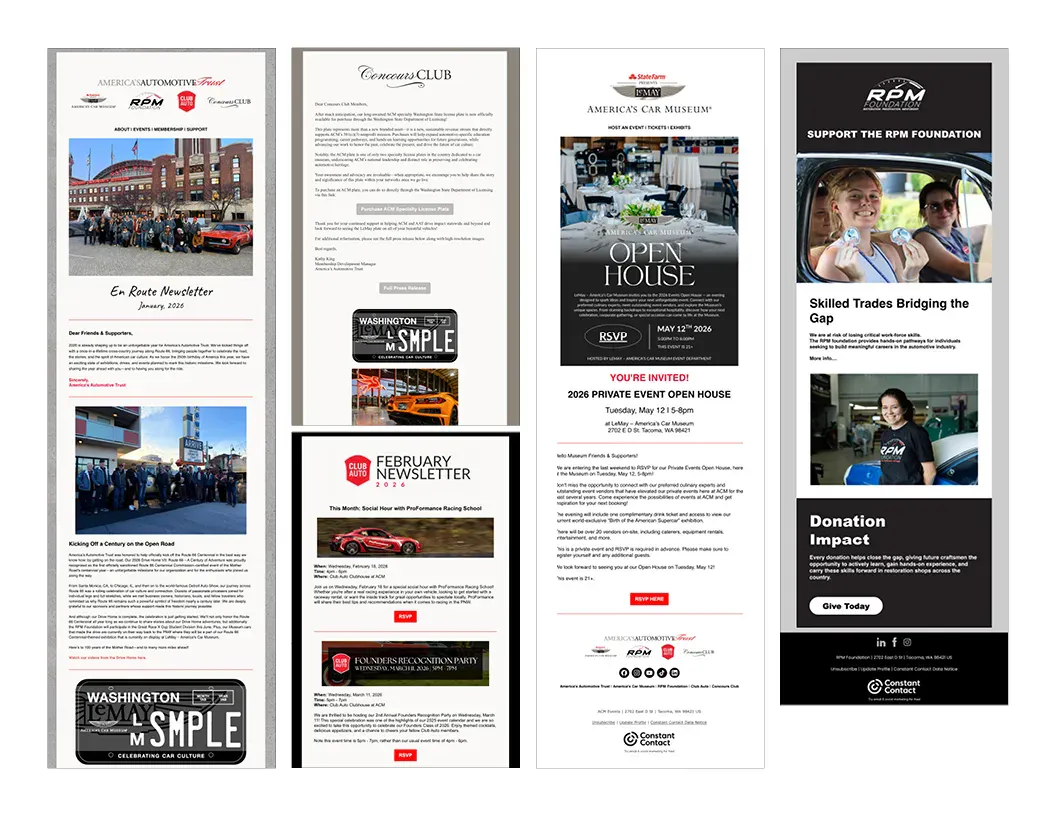
The bigger shift was cultural. Once the Trust had templates and role-based access set up, Jake stopped being the only person who could send an email.
Now, eight staff members across departments — education, private events, development, volunteer outreach — manage their own campaigns. They work within brand-controlled templates, so nothing goes out looking off-brand, but they're not waiting on Jake to do it for them.
"There are now department heads in different areas who can now own their email sends themselves, which not only creates more collaboration but also makes them feel like they're a part of the messaging as well."
That's a meaningful shift for anyone managing comms at a multi-department org. When the people closest to a program are also the ones communicating with its audience, the emails get sharper. The asks are more specific. The follow-up is faster.
And for Jake? "Now it's not all on me and my team as the marketing team to carry the weight of the email for the entire organization."
The part that actually moves tickets
Here's the number that matters most for a nonprofit with events: Jake consistently sees a 20–35% increase in event RSVPs tied directly to email campaigns.
One event in March broke an attendance record. Outside of web and social, email was the primary driver of clicks to the ticket page.
For an organization that relies on events to generate revenue, build community, and advance its mission, that's not a minor metric. It's how the lights stay on and how the programs keep running.
"If you look at it very black and white, the amount of money we spend subscribing to Constant Contact is significantly small compared to the amount of revenue we create and generate."
What other small teams can take from this
You don't have to run five brands for this story to apply to you. The core problem — one person carrying the email load for an entire organization, with systems that don't talk to each other — shows up constantly in small businesses and nonprofits.
A few things Jake's experience points to:
Fix the data connection first. If your CRM or contact database isn't synced with your email tool, you're doing double the work and introducing errors. That integration isn't exciting, but it's the thing that frees up everything else.
Templates aren't just about design. They're how you give other people in your org the ability to send emails without creating a brand consistency nightmare. Build them once, and you've bought yourself back hours every month.
The closer someone is to a program, the better their emails. When your events coordinator is writing the event email instead of routing it through marketing, you usually get a better email. Give them the tools to do it within guardrails.
America's Automotive Trust serves the automotive community through the LeMay – America's Car Museum, Club Auto, the RPM Foundation, and other brands. Learn more at americasautomotivetrust.org.

