

In today's crowded digital landscape, community and sporting organisations face a unique set of challenges. The passionate volunteers and dedicated staff who form the backbone of these groups are often stretched thin, juggling countless responsibilities.
While their focus remains on nurturing their community and developing their athletes, the need to attract new members, engage existing ones, and secure vital funding becomes increasingly difficult.
Many organisations grapple with a number of pain points:
Limited reach: Relying on traditional methods like flyers, local newspaper ads, and word-of-mouth can only go so far. Reaching a wider, more diverse audience beyond the immediate local area is a constant struggle.
Volunteer burnout: The same handful of committed individuals often shoulder the burden of communication, promotion, and administration - leading to exhaustion and a lack of fresh ideas.
Inconsistent communication: Without a clear strategy, communication can be ad hoc and reactive, leading to missed opportunities and a disengaged community. Members, parents, and supporters may feel out of the loop on important news, events, and results.
Stagnant membership & participation: Attracting new players, volunteers, and supporters is crucial for growth. Without a proactive approach, membership can plateau or even decline.
Difficulty in securing sponsorship: Proving value to potential sponsors is a challenge. Organisations need to demonstrate a strong, engaged audience to justify investment, but often lack the data to do so.
This is where digital marketing becomes a powerful ally. It's not about adding more work; it's about working smarter. By leveraging the tools and strategies outlined in this playbook, your organisation can overcome these hurdles and unlock new opportunities. Digital marketing provides the ability to:
Expand your reach and visibility: Connect with a broader audience, attract new members from diverse demographics, and build a stronger online presence that makes your organisation easy to find.
Streamline communication: Create a consistent, reliable flow of information. Keep your community informed about game times, results, events, and club news in real-time, reducing the administrative burden on volunteers.
Boost engagement and loyalty: Foster a vibrant online community where members, families, and fans can interact, share their passion, and feel a deeper connection to your organisation.
Drive membership growth: Implement targeted campaigns to attract new participants and volunteers, ensuring the lifeblood of your organisation continues to thrive.
Demonstrate value to sponsors: Build a robust and engaged digital following that provides tangible data and a clear return on investment for sponsors, making it easier to secure and retain vital partnerships.
This Marketing Playbook is designed to be a practical guide for organisations of all sizes. It's your roadmap to harnessing the power of Constant Contact’s digital marketing tools to not only survive, but thrive, ensuring your community and sporting organisation continues to inspire, connect, and grow for years to come.
Get ready to transform your approach to reaching current and prospective members with clear, concise communication that drives action - let's dive in!

Part 1: First Things First... KYM
This first step is all about WHO you are targeting. Knowing your customer ('KYC' in marketing-speak)... or, in our case, knowing your members (KYM) is key to any marketing activities. If you don't do this vital first step, you could end up wasting precious time and money on something that doesn't work.
This process involves understanding who you want to attract. In other words, who are your "ideal members"? What are their key traits & demographics? What does your organisation need to do to attract them? Some people break these down into one or more 'personas' (for example: a persona for club members, one for volunteers, one for sponsors / donors and so on), but we'll keep it fairly high level for now.
For example, let's say you help look after a Meals on Wheels Group. Your target audience for members are going to be over a certain age (either 50, or 65), but for volunteers could be anyone over 18 years of age. For sponsors /donors, it could be any company or corporation. This particular example shows just how varied the different target audiences are.
Discovering who your audience is and working out what resonates with them means you'll be able to use the right messaging to attract them. After all, it's going to cost you much less (money and time!) if your marketing is targeted correctly.
Once you've worked out who you want to attract, the next step is working out how to attract them. In the business world, we would generally look at our competitors and work out the different areas in which they excel vs. where we excel - but it can be a little different for a community or sporting organisation, as we may not be 'competing' with other organisations. Rather, perhaps you might be competing for a volunteers' free time, for a corporate donation or for someone's spare time that they can come and play their favourite sport with you & the other team members (for example).
For each of your personas (the member / player volunteer, the corporate donor or sponsor), have a think about the following and use that to form a 'messaging matrix'. This will help you understand more about what appeals to each group - you can then use that in your messaging on your website, on social media and in your emails in order to attract and engage.
Why would someone want to be a member of OR donate to OR volunteer for, your club or organisation? What would they get out of it?
What do you want them to do? It could be: play for a team OR donate money / time.
How would they 'do the thing you want them to do'? Is it by contacting you, or filling in an online form, or buying something from you?
💡 Andy's tip: Try not to attract everyone at once with the same message - it won't work and confuses things. Ensure your emails, social posts, advertising and website have the ability to cater to these different audiences.
This could be in the form of different emails or email automation workflows for different groups of people. Different web pages for each type of person (the member, the volunteer, the sponsor, etc) you want to attract. Different ads (with different text & imagery) to attract the various groups... otherwise it'll just confuse the reader. Yes, it takes more time - but you'll be rewarded with the right people because your message is clear.

Part 2: Contact Fields & Segmentation
Most clubs & organisations will already have a list of contacts to import into Constant Contact - just make sure you have marketing consent first! If you use a member management program, you may be able to setup an automated contact sync between it and Constant Contact using a third-party app called 'Zapier'.
Either way, it might pay to think about segmentation first. Doing so will reward you with less unsubscribes, higher engagement (clicks) and more email opens ...and we all want that, right?
Who Are They?
Think about your contact list for a moment. Are they current players / members or prospective ones? What about volunteers - current, past, prospective - or all of the above? Knowing where they fit is vital for being able to segment your contact data.
Remember - we want to send the right message to the right people, so being able to 'split' (segment) your contact list is probably going to be quite important!
As you can imagine, not all contacts are equal and, as such, your marketing message needs to change depending on the audience. There's that word again... "audience". It's vital to know who your contacts are because they're likely all at different stages of their 'marketing journey' with you, so a one-size-fits-all approach probably won't work.
Get the Timing Right
Imagine for a minute that you don't segment your contact list and you send an email to everyone (including past corporate sponsors), reminding players to sign up for the next season & pay their fees.
I can almost guarantee you'll get unsubscribes from those who aren't players, because this email would have been completely irrelevant to them. And now, you've just lost the ability to email your past sponsors asking them to renew because they've unsubscribed!
Similarly, imagine asking your volunteers about corporate sponsorship. Wrong list, wrong audience. Remember, a one-size-fits-all approach just doesn't work anymore.
It’s All About the Data
💡 Andy's tip: When it comes to your spreadsheet of contacts, adding a few extra columns for things like "contact type" (player, volunteer, sponsor / donor) and perhaps even when the person (if a donor) last donated time or money, will do wonders for your open rate - because it means you CAN send the right emails to the right people at the right time. Essentially, you're now 'segmenting' your list and your email sends. Segmented sends have better engagement rates because they're relevant for the audience.
Once this data is in Constant Contact, you can easily create segments for these different groups of people - making it super easy to email the right group! You can also get smart when it comes to building your emails - create one email but have the text & imagery change depending on who's getting it (more on this later).

Part 3: Website Sign-up Form
Great, so you've got your contact list nicely segmented and imported into Constant Contact - but what about new contacts? Growing your list is just as important as marketing to your existing contacts. This is where sign-up forms can help.
They're quick and easy to build, they can be embedded onto your website (or linked from your social media accounts) and are a great way to grow your list through new contact subscriptions.
💡 Andy's tip: Remember how we discussed contact segmentation in the previous topic? Just because a new contact is signing up for your eNewsletter through your website, doesn't mean you can't segment them either.
Make sure you add any relevant fields to your sign-up forms too... perhaps a question titled "What are you interested in hearing about?" and the options could be 'Players & Members', 'Volunteering' and 'Corporate Sponsorship' ...in other words, exactly reflecting the way you'd segment your list. This means new contacts can choose what they are interested in receiving emails about.
What's in it for you: More data from your contacts so you can target & engage them more effectively.
What's in it for them: Emails that are more relevant to their interests and thus, a lower likelihood to unsubscribe & a much higher engagement.
...it's win-win in my books!

Part 4: Email & Subject Lines
Email Structure
When building your emails, they should generally always follow this structure;
Logo
Banner
The content (personalised with the recipient's first name, at bare minimum) - with a call to action of some kind
Your contact details
Social media links
Unsubscribe link (we automatically add this for you)
Email Design
Your emails should also use consistent branding and colours, and generally the same font throughout. Consistency is key when it comes to design.
💡 Andy's tip: Try our Brand Kit tool - it goes and grabs the colours, logo and imagery from your website to make email building a breeze!
Use headings to help build 'sections' in longer emails - though generally, 'less is more' when it comes to emails. Putting useful & interesting content online is also a great way to boost your website's SEO - and then you can simply link to it from an email using a read more block.
What's Your Call-to-Action?
Every email should have a point or desired action. Think of it this way - what do you want the contact to do as a result of getting this email? Should they sign up as a player / member for the next season? Should they donate online? Should they register for an event or purchase a uniform online? Use buttons for your key call to actions, as they stand out.
As a general rule of thumb, stick to 1 or 2 clear call-to-actions in your emails and don't confuse the message. If you need different call to actions for different types of contacts, then it might make sense to use our dynamic content function to make the email appear differently for your various contact segments (eg. volunteers might see a section about upcoming events where you need volunteers, whereas members could see information about attending those same events as a player).
Subject Lines
Shorter subject lines seem to work better, but each industry and audience type (consumer vs. business) is different. The best thing to do is to try a few different variations (short vs. longer email subjects, subjects with vs. without an emoji, etc) by A/B testing your subject lines over time. This will let you see what resonates with your audience & come up with a winning formula. You can also try AI to suggest subject lines for you.
One thing that definitely works is personalising the subject line. You should see an increase in your email open rate when compared to a non-personalised subject line.
💡 Andy's tip: It's always a good idea to check your reports after you send an email. That way, you'll know who's engaged and which links they're clicking. You can even trigger automations to run based on whether contacts do (or don't) open your email, or whether they do (or don't) click on certain links. More on that in the next section.

Part 5: Automations
It's definitely worth considering automations as part of your marketing. After all, they're very good time-savers and just because it's automated doesn't mean it lacks that personal touch. Just like a regular email, an automated one can be personalised with recipient data and can include information specific to whatever your contact is interested in.
In many ways, an automated email is often more effective than a manually-sent one, because they automatically get the timing right based on clicks, opens & engagement (or lack thereof).
Automations for Community & Sporting Organisations
Why Automate?
Saves time: Automate repetitive communication tasks & free up time to focus on high-value activities.
Improved lead nurturing: Consistent and timely follow-up keeps leads engaged & moves them through the funnel, getting them towards your goal - be it signing up as a member, donating, volunteering, etc.
Personalisation at scale: Segmenting your audience and sending targeted content makes communications more relevant and impactful.
Increased conversions: Nurtured prospective members, volunteers or corporate sponsors are more likely to convert into active ones.
Data and analytics: You'll still get insights into open rates, click-through rates, and engagement, allowing you to refine your strategies.
Brand building: Automations help to maintain brand presence in the inbox, positioning you as a knowledgeable, trusted and reliable expert.
Automation Ideas
Send a thank you email whenever a new contact joins your mailing list from your website, displaying the upcoming events. It's also a great way to introduce your club and show some recent photos - or even videos from your YouTube channel. (⏳ Setup time: 5 minutes or less - view guide)
Send a quarterly-recurring email to contacts with all of the upcoming events where players or volunteers are needed. Segment the email based on the contact type - so players see content relating to matches they can attend and volunteers see content about volunteering at said matches. You could also set up an annually-recurring email for corporate sponsors to thank them for previous donations, show them how their donation has helped your club or organisation throughout the year and gauge interest about sponsoring again. Spend less time chasing people - automate it! (⏳ Setup time: 5 minutes or less - view guide)
Send educational content (often called a 'nurture series') to new players & another to new volunteers, explaining how everything works - including sharing important material or documents they need to read. This could be an email series over time, eg. 4 emails over 4 weeks. Additionally, you could get super fancy and put a link or button in all of your general & eNews emails which, when clicked, will trigger this series to start automatically for those that click it! (⏳ Setup time: 10 minutes - view guide)
Send an automated email once someone signs up as a club member, thanking them for their support and providing details about upcoming matches or events.
Trigger a secondary action based on what a contact clicks in your emails. For example, when a contact clicks the "Send me the uniform price list" link in your email nurture series, you can have Constant Contact send them the pricing PDF via email.
Tag contacts with additional data automatically, based on what they do / don't do when they receive certain emails from you.
💡 Andy's tip: There's a lot of ideas here, but I recommend starting small with an automated welcome email to begin with ...you can always build out from there over time!

Part 6: Social Media
Last of all, let's briefly talk about social media. Although you don't "own" the followers on social media (unlike email), it's still a channel worth marketing on. It's a great way to advertise upcoming games / matches, celebrate wins, promote volunteering (and thank existing ones!), and to build your club's brand.
With Constant Contact, you can post on social channels whenever you like. You can also schedule posts, as well as share an email on social media - a great way to save time and share already-made content, rather than reinvent the wheel each time. Our AI assistant can also write the post for you - just enter a prompt and off it goes!
💡 Andy's tip: I often get asked how to turn social media followers into email contacts. We have a great tool for this called Lead Magnet. It's a fantastic way to capture lead information and convert social followers into marketable contacts. More on this in the next section...

Part 7: Lead Magnet
As mentioned above, you don't "own" your social media followers - which poses a bit of a problem if you've put all of your eggs into the one (social media) basket.
If the algorithm suddenly changes overnight or you get locked out of your social media account, there goes your entire marketing strategy! Getting help from a human at most social networks is also increasingly difficult. So how do we convert a 'social follower' into a marketable contact on your list? The answer... is a lead magnet!
A lead magnet is like a mini survey that sits on a landing page which we host for you. It's a great way to turn a social follower into an email contact that you own and have permission to directly market to - with personalised, trackable emails.
It's easy to setup too. Just enter a prompt into our lead magnet's AI builder and it'll create the mini survey with interactive question-pages, answer-buttons & even a nice background image for you in less than a minute.
Everything is completely customisable too - including the form at the end (where you ask the contact for their name & email address).
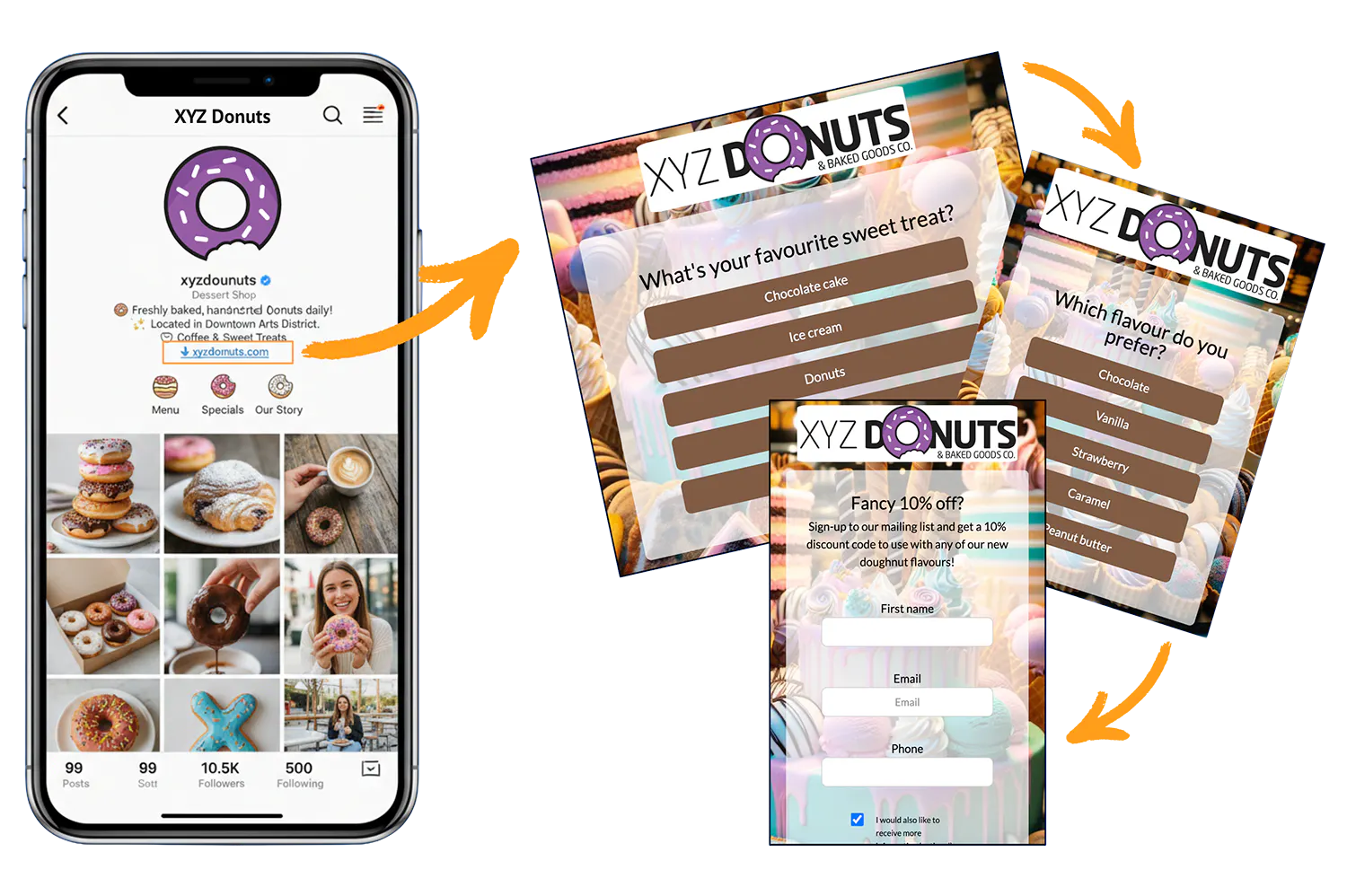
Once setup, you'll be provided with a public link to the survey - which you can add to your social media profile as a link in your bio (as shown in the left side of the image above).
When someone visits your lead magnet, they can click the buttons to answer your interactive survey & fill in their information at the end. The process of doing so adds them to your desired contact list in Constant Contact.
From here, you can setup a welcome email to send to them, or just email them sales emails, newsletters or whatever else you've promised them. Keen to learn more about our Lead Magnet function? Follow our how-to guide.
💡 Andy's tip: Lead magnet's work best when there's an incentive on offer for joining your list. For example, "Help us pick our next doughnut flavours and you'll get a 10% off code to try them when they're released!".

Lead Magnet Ideas
Stuck for ideas on what you might do with a lead magnet? Here are some ideas you could use as AI prompts when setting up your lead magnet...
What sports are you most interested in playing or supporting?
What merchandise should we stock in our shop?
Tell us about what you'd like to eat and drink in our clubhouse cafe / restaurant?
What days and times are you generally available for training and games?
How far are you willing to travel to attend games or training sessions?
Remember: Lead magnet is fully customisable, so you can ask a range of questions all within the one magnet (across multiple survey 'pages').

Support & Resources
New to Constant Contact? Get started with a free trial today! If you get stuck or need a hand with anything, please reach out to our support team, explore the support knowledgebase or chat with others in the Constant Contact Community.
Here are some sporting club / community organisation marketing content & blog posts you might enjoy;
The Power of Community: How to Grow Your Small Business Through In-Person and Virtual Relationships
10 Proven Strategies to Increase Online Donations for Your Organisation
Understanding Goals of a Nonprofit Organisation: A How-To Guide
Happy marketing!

